❖ ❖ ❖
Then and Now: A Short History of the Cuban Cigar
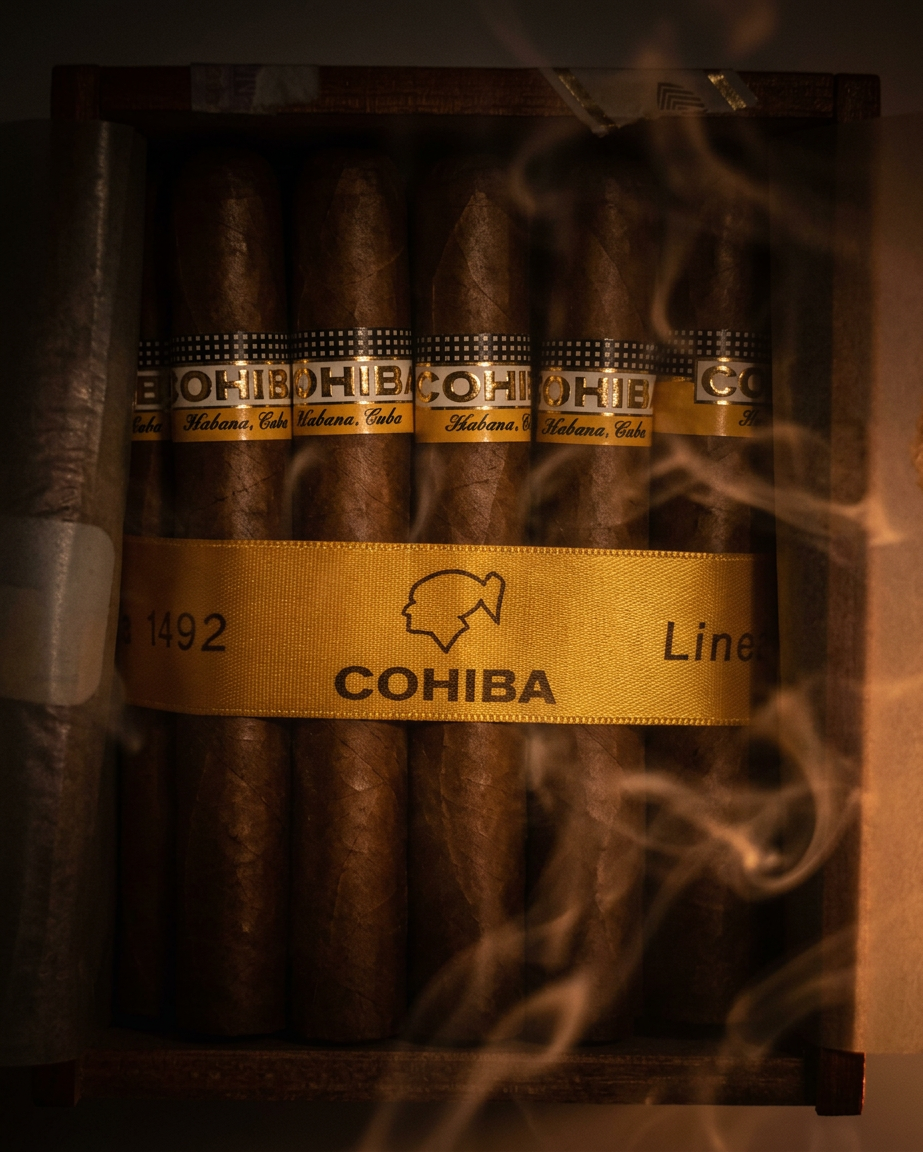
I. The Leaf and the Empire
The story begins, as it must, before Cuba was Cuba. The Taíno people of the Caribbean were rolling and smoking tobacco leaves centuries before a European ever set foot on the island. Columbus's own scouts came back from the Cuban interior describing men carrying smoldering bundles of dried herb, a sight so unfamiliar to Spanish eyes that it took decades to even find a word for it. That word, eventually, became cigarro.
For two hundred years afterward, the Spanish crown treated Cuban tobacco as something to be shipped home and processed in Seville — Cuba grew the leaf, but Spain rolled the cigars. It was not until 1817, by royal decree of Ferdinand VII, that Cubans were permitted to manufacture finished cigars on the island themselves for export. The effect was immediate and total: within a generation, Havana had become the undisputed capital of a luxury good the entire Western world wanted. The names founded in that first golden rush are still spoken with a certain reverence at any serious tasting table — Por Larrañaga in 1834, Ramón Allones not long after, Punch in 1840, H. Upmann in 1844, Partagás in 1845, Hoyo de Monterrey in 1865, Romeo y Julieta in 1873.
By the time Pushkin's generation of European travelers were forming their first impressions of the wider world, the Havana cigar was already a fixed point of cosmopolitan life — alongside French champagne, English wool, and the other signifiers of a gentleman who had been somewhere.
II. A Free Port at the Crossroads
It is worth pausing here on Odessa itself, because the city's own 19th-century story runs on a strikingly similar rail. From 1819 to 1858, Odessa held porto franco status — a free port, exempt from the usual imperial duties, built explicitly to draw in trade and the people who carried it. The result was a city unlike anything else in the Russian Empire: Greek shipping families, Italian merchants tracing their presence back to Genoese trading vessels of the 1200s, French émigrés, and a Jewish community that would grow to be among the largest in Europe, all doing business within a few streets of one another. Pushkin, living there in internal exile in 1823–24, wrote home that the air itself seemed filled with all of Europe — French spoken everywhere, European newspapers on every café table.
A free port built on exactly that kind of cosmopolitan commerce is, by its nature, the sort of place where a fashionable European luxury, Havana tobacco very much included. It would have found its way onto a café table sooner rather than later. We can't point to a single surviving ledger and say here, but the conditions could hardly have been better suited to it. It is, at the very least, a city that has always known how to receive the world's good things.
III. Revolution, Embargo, and a New Map of Trade
The 20th century broke the old order cleanly in two. The 1959 revolution nationalized Cuba's cigar factories overnight — many of the most experienced hands in the trade left the island within the year, scattering to the Canary Islands, to Honduras, to the Dominican Republic, taking with them both expertise and, in several cases, brand names that would go on to live a second life entirely independent of Cuba. Then, in 1962, the United States imposed its embargo, severing what had been Cuba's largest market in a single stroke.
Cuba's answer was to turn east and turn to Europe. Spain, France, Switzerland, Belgium, Holland, and Britain became the new core of the trade and the Soviet Union and the rest of the Eastern Bloc became steady customers too, even if their orders ran more often to machine-made and cheaper handmade lines than to the premium leaf reserved for Western Europe.
IV. Habanos Today
The modern industry took its current shape in 1994, when the Cuban state's Cubatabaco entered a joint venture with the Spanish tobacco group Altadis to form Habanos S.A. Split evenly between Cuban state ownership and private capital, and private capital, and still holding the worldwide monopoly on genuine Cuban cigar sales. The familiar marquee names sit under its umbrella: Cohiba, Montecristo, Bolívar, Romeo y Julieta, and more than twenty other protected marcas. In 2024, the company reported revenues of roughly $827 million, up sixteen percent on the year before, with Spain, Switzerland, the UK, and increasingly China leading the export markets.
V. 2026: A Toast Against the Wind
This year was meant to be a celebration: Cohiba turns sixty in 2026, and the cigar world's marquee event, the Festival del Habano, had sold every available ticket through official distribution channels well before the doors were due to open. Instead, in mid-February, Habanos S.A. postponed the festival indefinitely not for any failure of the cigar itself, but because Cuba is living through one of its most severe economic crises in decades: fuel shortages, rolling power outages, hotels announcing temporary closures. The organizers said plainly that the country's people had to come first, and that a celebration built on luxury was not one they could justify holding while ordinary life was this hard.
It is, perhaps, the most honest note to end on. The Cuban cigar has survived an empire's monopoly, a revolution, an embargo, four decades of Cold War back channels through ports very like our own and now finds itself enduring quietly again, waiting for its moment to light up. A club that has spent its own first year meeting in a vaulted room while the city outside it is at war will recognize the shape of that endurance better than most.
At a Glance — A Cigar Timeline
Pre-1492 — Taíno peoples of the Caribbean roll and smoke tobacco leaves; Columbus's crew are among the first Europeans to witness it.
17th–18th c. — Spain imports Cuban leaf and rolls it in Seville; Cuba grows, Spain manufactures.
1817 — Ferdinand VII permits Cuban manufacture and export of finished cigars; Havana's golden age begins.
1834–1873 — The great houses are founded: Por Larrañaga, Ramón Allones, Punch, H. Upmann, Partagás, Hoyo de Monterrey, Romeo y Julieta.
1819–1858 — Odessa holds free-port (porto franco) status; a cosmopolitan merchant city of Greeks, Italians, and French takes shape — the kind of place where a fashionable Havana leaf would have felt at home.
1959 — Cuban Revolution nationalizes the cigar industry.
1962 — US embargo cuts Cuba off from its largest market; trade pivots to Europe and the Eastern Bloc.
1960s–80s — Soviet hard-currency shops sell Cuban cigars as classic homecoming luxuries.
1994 — Habanos S.A. is formed as a joint Cuban–Spanish venture, holding the global monopoly on genuine Habanos.
2024 — Habanos S.A. reports $827 million in revenue, up 16% year-on-year.
2026 — Cohiba turns 60. The Festival del Habano is postponed indefinitely amid Cuba's economic crisis the trade endures, quietly, once again.