❖ ❖ ❖
The Night Before the World Changed Its Mind
Friday, February 28, 2026. 8:00 PM.
Somewhere beneath one of the oldest stones in the city.

There is a place in Odessa — and I will not give you the address, because some things must be earned, and also because if you need an address in Odessa, you're probably not ready for what's inside — where the vaulted ceiling has witnessed more history than some museums would dare claim. The brickwork looks medieval despite dating from the early 19th century, and the chandelier has hung from its chain long enough to have opinions, and strong views on modern architecture.
Descend into these three connected rooms and you don't feel like you're going down. You feel like you're going back — to when men settled the world's affairs over good tobacco, fine liquor, and better arguments, and the world occasionally listened. Sometimes it even took notes.
This is where the Cesar Autonne Cigar Club held its February meeting. Twelve people. In Odessa terms, not merely a cigar club — a gathering united by one essential thing: love of this city. Which, as any Odessan will confirm, is the only love that never asks where you've been and always takes you back.
In Odessa, everyone is a character whether they audition or not. The city doesn't produce wallflowers. It produces people — fully formed, magnificently opinionated, and generally convinced they could run both the city and the universe more efficiently than whoever is currently attempting it.
New members arrived that evening with the ceremony reserved for visiting dignitaries — which in Odessa means everyone who brings good tobacco and doesn't talk too much before the first draw.
A local professor of medicine, formerly of the London medical school — a man of such distinguished bearing you immediately wanted to confess three lifestyle choices you'd been keeping quiet. He selected his cigar the way surgeons select instruments — deliberately, confidently, having apparently already booked the recovery room.
A professor of macroeconomics from the Polytechnic University, who had spent so many years analyzing complex interconnected markets that he now applied the same framework to everything — including, one suspected, the brandy allocation and the optimal angle at which to hold a torpedo.
A Frenchman, an Italian with a Milanese accent, and a gentleman from Luxembourg. Odessa collects interesting people the way other cities collect pigeons — enthusiastically, indiscriminately, and with considerable pride.

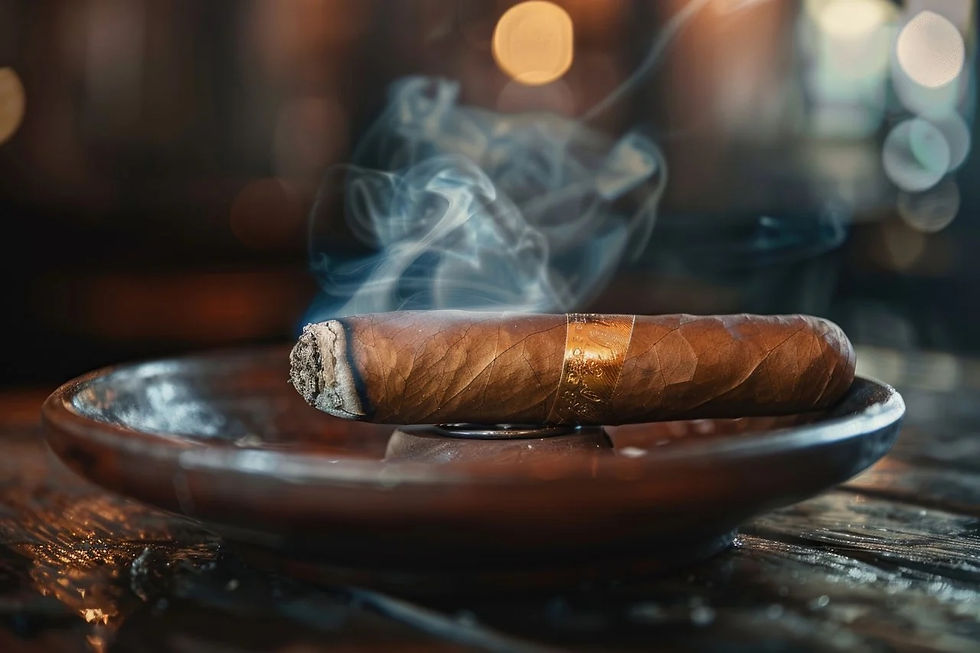
The cigars deserve their own paragraph. In Odessa, even the supporting cast gets a monologue.
Ashton Heritage, Cohiba, Diamond Crown, Gurkha, and Zino burned beautifully — the room thick with smoke that belongs only to good tobacco in stone rooms, ancient and present at once. Conversation found its level, as Odessa conversations do — immediately deep, frequently philosophical, punctuated by laughter so genuine it competed with the chandelier for the room's warmest light.
The topic, inevitable as the tide: the war. Specifically — its possible end. Negotiations. Scenarios. A geopolitical chess match four years running. The Cesar Autonne Cigar Club and the REVA Foundation, joining forces to preserve Odessa's 19th-century cultural legacy while investing in its contemporary artistic renaissance. A platform where business and culture collaborate, where heritage meets ambition and, presumably, good tobacco is an essential working condition.
February in Odessa. Cold, quiet, the Black Sea doing its patient eternal things less than a kilometer away, unbothered by human affairs as it had been for millions of years. The sirens stayed silent all evening. Even they, apparently, had somewhere better to be.
Nobody at that table knew — that in approximately 10 hours, a different and considerably louder conversation would begin on the other side of the world. That by morning, the situation in the Middle East would acquire sudden, lurching new weight. That news alerts would arrive before coffee, before reason, before anyone had returned from the warm stone room and the long ash and the easy laughter of the night before.
History does not check your social calendar. It does not RSVP.
But here is what I will tell you about that Friday in February: twelve people sat in a vaulted room beneath one of Odessa's oldest stones — businessmen and reporters, linguists and collectors, locals and wanderers from five countries — and they talked, smoked, disagreed politely, agreed loudly, and proposed futures with the full confidence of people who fully intend to be present for them.
The ash held long. As good things — and stubborn cities — sometimes manage to do.
The Cesar Autonne Cigar Club meets monthly. Zero cancellations.
February 2026, Odessa